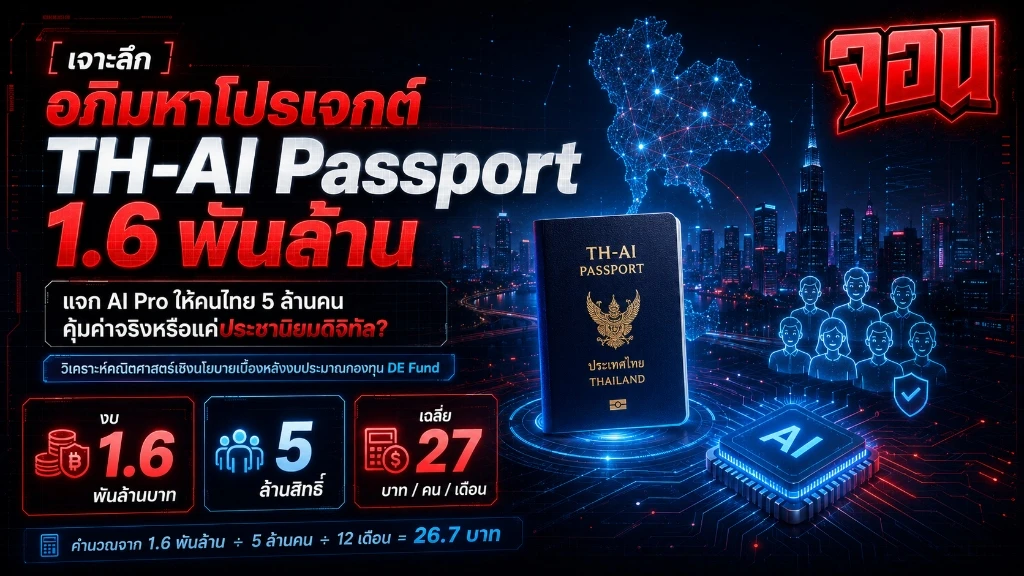
Is it a smart national investment or digital populism? That is the argument surrounding TH-AI Passport, a Ministry of Digital Economy and Society initiative to give 5 million Thai people free access to a Pro-level AI tier. The budget is about 1,621 million baht, usually rounded to 1.6 billion.
The debate sharpened after a public hearing, the "TH-AI Passport Forum," on June 11, 2026, where government and private-sector representatives responded to criticism. All figures below are as reported in the original Thai analysis and are not independently verified here.
The case for
- It narrows the digital divide. Freelancers, provincial students and small online sellers who cannot spend roughly 700 to 800 baht a month on AI tools would get access comparable to what large companies use.
- Wholesale pricing. A national bulk deal reportedly works out to about 27 baht per person per month, around 96 percent below retail.
- Local cloud infrastructure. Routing access through an anonymizing domestic cloud gateway could grow revenue for Thai cloud providers.
The case against
- Rate limits. Users may face daily question caps, and may not be able to use an API key in their own programs the way a direct purchase allows. That weakens the value for anyone trying to build a business with it.
- Low-productivity use. If people use the access for casual chat, or leave accounts idle instead of pursuing "Learn to Earn," the money is wasted.
- Procurement transparency. Critics in the opposition and legislature question how quickly the e-bidding process was completed and why a first installment was released when only planning documents existed.
A proposed fix: pay for what is used
The ministry is reportedly planning to amend the contract through an attached memorandum of understanding. Today's structure is a per-head lump sum, which risks paying for accounts nobody uses. The proposal is pay-per-use, billed by token volume.
If that happens, taxpayer money would go only to actual usage, which would reduce waste and answer one of the strongest criticisms.
What I would want to see
- Published rate-limit specifications, so users know what they are getting before they sign up
- A training curriculum, so citizens learn to use the tool productively instead of just having it
- Clear contract terms with foreign partners, including data handling
- Usage reporting, so the public can see whether the program works
My take
I think TH-AI Passport is a good and necessary idea in principle. Thailand cannot afford to fall behind on AI skills, and giving ordinary people real tools is better than giving them a slogan.
But a good idea does not excuse a weak process. The real challenges are procurement transparency and the technical details of contracts with foreign partners. The idea works if the execution is clean, and fails if it is not.
The big question to leave you with: should the state hand out AI access, or should it spend that money teaching people how to use it first?
Written by Ko John. Based on the Thai original on kojohn.com. Budget, per-head cost and procurement claims are as reported by the author.
Original Thai analysis available at /articles/th-ai-passport-pros-cons-analysis