Posting every day is not the hard part. Staying sane while doing it is. Especially when you don't have a five-person production team and you are building your channel alongside a full-time day job.
This guide breaks down how a solo creator with a full-time job ships 30 short-form videos a month without burning out—covering the 5-phase batch system, human-vs-AI task division, how to avoid robotic scripts, and a weekly schedule you can copy.
Why Making One Video From Scratch Every Day Destroys You
When most solo creators decide to take content seriously, they make a pact with themselves: "Every evening after work, I will research, write, film, edit, and publish one video."
That pact usually survives about nine days.
Why? Because making a single 60-second video actually requires five completely different cognitive modes:
- The Analyst (Research): Hunting for topics, checking facts, and reading sources.
- The Writer (Scripting): Turning messy notes into a punchy two-line hook and a tight narrative arc.
- The Gaffer & Sound Tech (Setup): Clearing the desk, setting up the tripod, adjusting the key light, and checking microphone gain.
- The Performer (Filming): Putting on a clean shirt, summoning on-camera energy, and delivering lines clearly.
- The Editor (Post-Production): Cutting dead air, color grading, adding b-roll, captioning, and exporting.
Making one video daily forces your brain through all five modes every 24 hours—spending 25 minutes setting up lights just to record 90 seconds of talking.
In my experience balancing a full-time role in social media with my own channels, it isn't the total minutes of work that cause burnout—it is the context-switching tax.
The 5-Phase Batch System: One Brain Mode Per Session
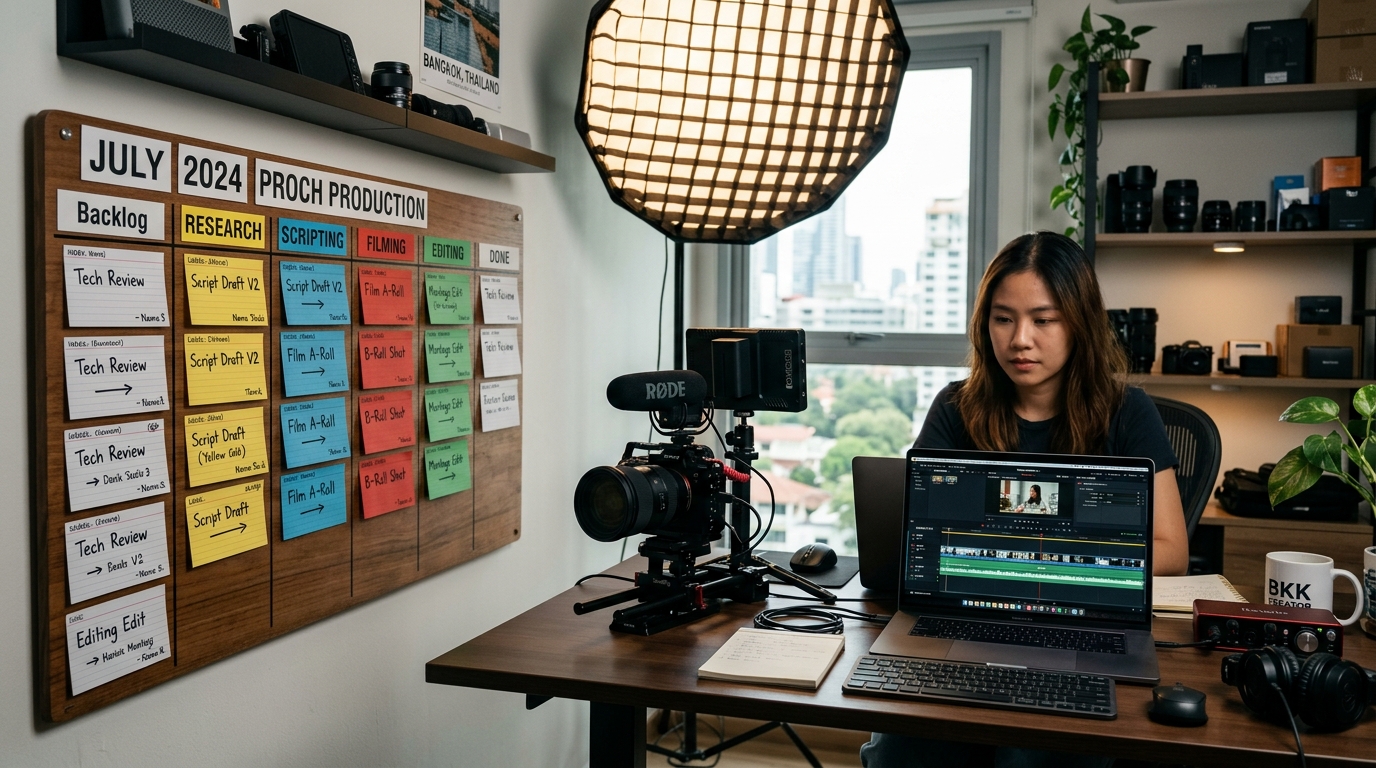
The cure for context switching is treating your studio like a small assembly line. Instead of building one finished car from Monday to Friday, you build 7 chassis on Monday, 7 engines on Tuesday, and paint all 7 bodies on Wednesday.
Here is how the 5-phase batch workflow breaks down across a week to yield 7 to 8 videos (roughly 30 videos a month):
Phase 1: The Research Block (Topic & Fact Harvesting)
Open a single board and collect 8 to 10 topic ideas at once. Use comment questions from last week's posts, industry news, and official tools like TikTok Creator Search Insights or YouTube Creators studio analytics. Do not write full scripts yet—just drop the core angle and verifiable source links under each card.
Phase 2: The Scripting Block (Hooks & Bullet Outlines)
Sit down for two focused hours and write all 7 to 8 scripts back-to-back. Because your brain is already warmed up in "writer mode," script number four takes half the time of script number one. Write out your first two hook sentences word-for-word, structure the body as clear talking points, and end with your closing question.
Phase 3: The Filming Block (Lights On Once, Shoot Everything)
Set up your camera, tripod, key light, and microphone once. Shoot all 7 to 8 videos in a single two-to-three-hour session.
- Pro tip: Keep three or four different shirts draped over a chair next to your desk. Swapping your shirt and slightly shifting your background prop or lighting angle between takes takes 30 seconds and keeps your feed from looking like every clip was recorded in the same hour.
Phase 4: The Editing Block (Assembly Line Post-Production)
Do not edit one video completely before starting the next. Batch the sub-steps across all 7 timelines:
- Run rough-cut silence removal and A-roll selection on all 7 timelines first.
- Apply your base color grade and audio normalization preset across all 7 timelines.
- Layer in b-roll, screen recordings, and captions.
Phase 5: The Packaging & Scheduling Block
Write all 7 captions, pick your cover frames, toggle any required commercial disclosures, and schedule the posts inside the platform studio tools. Once this block is done, your daily publishing happens automatically even if you get stuck in Bangkok traffic.
Human vs. AI: Who Does What in the Workflow?
AI is a great force multiplier for a solo creator—if you put it in the right seat. If you ask AI to be the host and the thinker, your channel loses its soul. If you treat AI like a fast junior production assistant, you save hours every week.
Here is the division of labor that keeps quality high and workload low:
| Workflow Step | What AI Can Help With | What Must Stay 100% Human (You) |
|---|---|---|
| 1. Research | Summarizing long technical reports, organizing messy notes, and spotting counterarguments. | Verifying every primary source link and deciding whether a topic matters to your audience. |
| 2. Scripting | Generating 5 alternative wording options for a rough hook or trimming a bloated 400-word draft down to 200 words. | Your personal opinion (My take), humor, lived stories, and conversational cadence. |
| 3. Filming | Nothing. (Keep your real face, real voice, and real energy on camera.) | On-camera delivery, pacing, eye contact, and genuine expression. |
| 4. Editing | Auto-detecting silences, flagging shaky or out-of-focus clips, and generating initial caption transcripts. | Story pacing, choosing which visual moment lands the point, and final color/audio check. |
My Real Tool Stack and Step-by-Step Setup
[JOHN: ระบุรายชื่อเครื่องมือและขั้นตอนที่ใช้]
(Regardless of which specific software tools you prefer, the core principle of a solo creator's setup is friction reduction: keep your camera and microphone ready to record within two minutes, use saved project templates for 9:16 and 16:9 timelines, and automate repetitive rough-cut cleanup so your energy goes into storytelling rather than file management.)
Three Signs Your Content Looks "Too AI"—and How to Fix It
Viewers in 2026 and 2027 have an instant radar for lazy AI-generated scripts. If your retention drops in the first five seconds, check whether your scripts have fallen into these three traps:
- The "Not X, But Y" AI Cadence: AI loves writing sentences like, "Success in content creation isn't about working harder—it's about working smarter in a rapidly evolving digital landscape." Real people in Bangkok do not talk like corporate press releases over iced coffee.
- The Fix: Read every script out loud before hitting record. If a sentence sounds like a translated textbook, cross it out and say it the way you would explain it to a friend at lunch.
- Symmetric Lists With Zero Point of View: AI defaults to neutral summaries ("On one hand X has pros, on the other hand Y has cons").
- The Fix: Force yourself to include one concrete opinion in every video: "If I were starting today with a 5,000-Baht budget, I would skip X and buy Y because..."
- Zero Specific Local Context: AI scripts speak in universal abstractions.
- The Fix: Anchor your examples in specific details—what happens when you shoot outside at noon in Thai heat, or how a feature behaves on an actual timeline you edited this week.
Sample Weekly Schedule for a Solo Creator With a Day Job
You do not need 40 free hours a week to ship 7 to 8 videos a week (30+ a month). Notice how this schedule leaves two weekday evenings and Sunday afternoon completely free:
- Monday Evening (1.5 hours): Research Block — Review last week's comments and search insights; lock 7–8 topics and verify source links.
- Tuesday Evening (2 hours): Scripting Block — Draft hooks and bullet scripts for all 7–8 videos; read aloud to strip out robotic phrasing.
- Wednesday Evening: OFF (Rest, gym, family—zero production work).
- Thursday Evening (1.5 hours): Prep Block — Gather b-roll, screen recordings, or reference graphics needed for the weekend shoot.
- Friday Evening: OFF (Protect your social life so you don't resent your channel).
- Saturday Morning (2.5 hours): Filming Block — Set up lights once, swap shirts between sets, and record all 7–8 A-roll videos.
- Saturday Afternoon / Sunday Morning (3 hours): Editing & Scheduling Block — Batch rough cuts, apply color/audio presets, add captions, and schedule the week's queue.
My take
People love romanticizing "the hustle" in the creator economy—bragging about editing until dawn and never taking a day off.
In my experience, hustle gets you through your first 30 days; systems get you through your first three years. Neither YouTube nor TikTok hands out a trophy because you suffered over your timeline at 2:00 AM. Moreover, while consistency helps you improve faster, no workflow can guarantee a specific number of new followers—what a batch system does guarantee is that you stay consistent long enough to let your skills compound without wrecking your health or your day job.
Let AI handle the repetitive heavy lifting—organizing notes, trimming dead air, and transcribing captions—so that when the red recording light turns on, the person on screen is rested, sharp, and unmistakably human.
Quick Summary
- Kill the daily context switch: Making one video from scratch every day forces your brain through 5 different roles daily. Batch by role instead.
- Run a 5-block factory line: Separate Research, Scripting, Filming, Editing, and Scheduling into dedicated sessions.
- Keep AI as the assistant, not the host: Use AI for research synthesis, rough drafts, and rough-cut cleanup; keep source verification, opinions, humor, and on-camera performance 100% human.
- Read scripts aloud: Strip out textbook AI phrasing before recording, and protect two rest evenings every week.
Which step of your content process eats the most time right now?