Think about the last time you bought something online. Did you type the product name into a marketplace, or did you scroll past a clip, think "oh, that's neat," and buy it a minute later without ever planning to?
More and more Thai shoppers are doing the second. This shift is called Discovery Commerce, and it is changing who wins in online retail.
From search to discovery
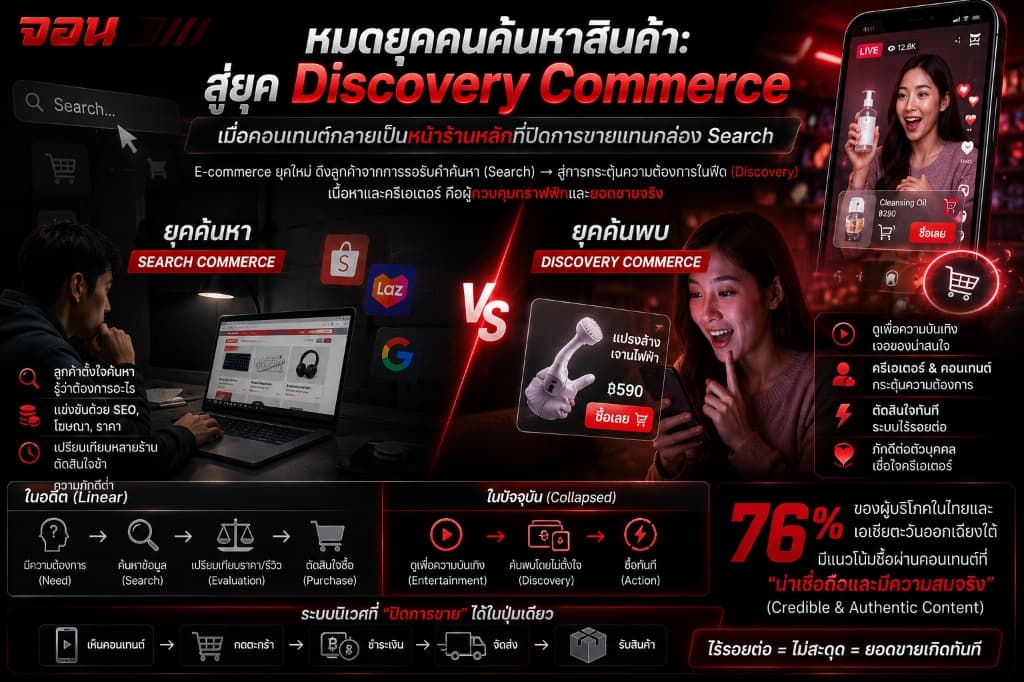
The old journey was linear: a need, a search, a price and review comparison, a purchase.
The new journey is compressed: entertainment, unplanned discovery, immediate action through a frictionless checkout.
The feed has become a living magazine and a glass storefront at the same time. Shoppers expect the platform to show them things they will like, with no effort.
Search commerce vs. discovery commerce
| Search commerce | Discovery commerce | |
|---|---|---|
| Where | Shopee, Lazada, Google | TikTok Shop, Reels, Facebook Live, Shopee Video |
| Purchase intent | High | Low to moderate |
| Trigger | A problem or need | Emotion and entertainment |
| Speed to purchase | Moderate to slow | Very fast |
| What converts | Price, ratings, shipping | Creator credibility, realism of the clip |
| Loyalty | Low, shoppers switch for small price gaps | Higher, toward the creator |
| Who controls traffic | The platform's search and ad bidding | Content and creators |
Shoppertainment
The engine behind this is "shoppertainment," shopping fused with entertainment. Thai audiences like fun and dislike hard selling. Content that tells a story, solves a visible problem or shows behind-the-scenes work outperforms spec sheets and price lists. A search shopper compares numbers. A discovery shopper buys a feeling and a solved problem, which is much harder for a competitor to copy.
The article cites a claim that 76 percent of consumers in Thailand and Southeast Asia are more likely to buy through content they find credible and authentic. The article gives no source for that figure, so treat it as unverified. The direction, though, matches what many sellers report.
The checkout is part of the content
Great content still loses sales if buying is slow. Compare:
- Old flow: Facebook post, inbox or LINE chat, wait 10 to 30 minutes for an admin, bank transfer, send a slip, type your address.
- Discovery flow: Product details, options, payment and address on one screen, saved data, two or three taps, tracking in the same app.
The article claims the old flow loses 50 to 80 percent of carts, again without a cited source. Even if the real number is lower, the logic holds: every extra step is a place to lose the buyer.
Three strategies for Thai sellers and creators
- Sell the transformation, not the specs. Pain point, a real demonstration of the fix, then a call to action. Show a vacuum cleaning spilled condensed milk off carpet. Do not recite its suction power.
- Build a credibility bridge. Say what the product is not good at. "Effective, but loud" or "needs charging often on the top setting" makes every positive claim more believable.
- Respect the three-second rule. Use the first three seconds for a question, a surprising result or an odd image. Spend the middle on demonstration or story. Close with a clear cart prompt.
My take
A seller who opens a store on a marketplace, posts white-background photos, undercuts competitors and waits for search traffic is in a dangerous position. Search creates a price war, and overseas factories can always undercut on raw cost.
Reaching buyers in the feed, before they ever open a search box, is how a seller can hold a sustainable price. Creators become something close to a 24-hour storefront, and smart brands will either build content teams or form long-term creator relationships.
The search box is not going away. It will keep serving detergent, toothpaste and cables. But fashion, beauty, gadgets, lifestyle goods and impulse-friendly food and home products will increasingly be won in the feed.
Written by Ko John. Based on the Thai original on kojohn.com. Statistics flagged above are unsourced in the original.
Original Thai analysis available at /articles/discovery-commerce-tiktok-shop-shopping-behavior