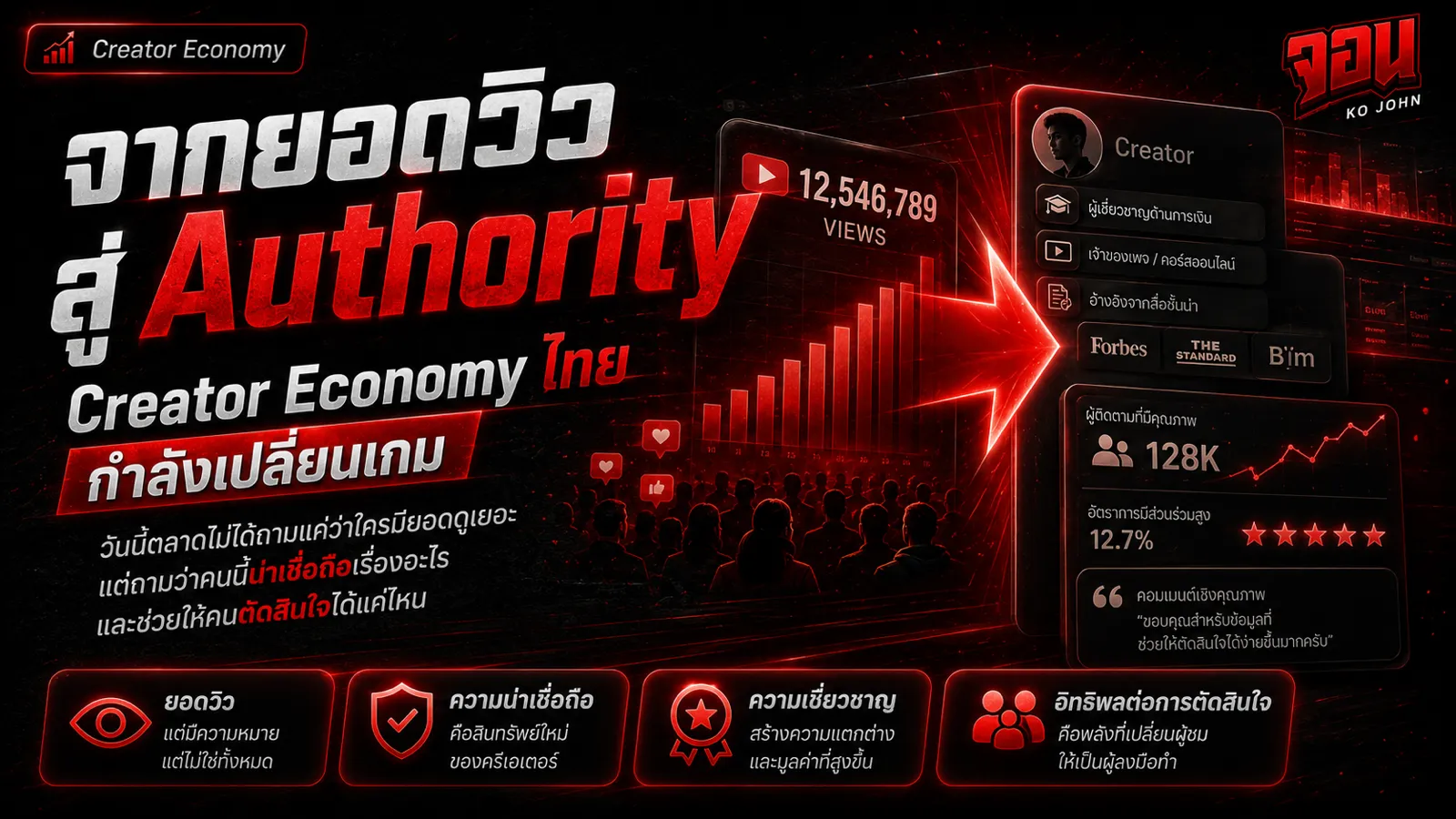
For years, the Thai creator market ran on one language: views, followers, engagement rate, reach. Brands used those numbers to decide who to hire, and creators used them to decide what to make. That language is not wrong. It is just no longer enough.
The shift now underway is from reach to authority. The question brands ask is moving from "how big are you?" to "what are you credible on?"
Views show visibility, not belief
A viral clip proves that a lot of people saw something. It does not prove they understood it, trusted it, or acted on it. That gap matters most in categories where the buyer is nervous: EVs, AI tools, finance, health, education, software and enterprise services. In those markets a famous face does not reduce uncertainty. A trusted explainer does.
Views remain the front door. They bring people to the room. Authority is what makes them stay and believe what they hear there.
Authority is built by repetition, not by one hit
Authority is not a title and it is not a certificate. It is a pattern that an audience can observe over time:
- Which topics the creator keeps coming back to
- How they choose and present information
- Whether they admit what they do not know
- What sponsorships they accept, and which they refuse
- How they react when they get something wrong
A creator does not need to be the biggest in the market. They need to be the clearest in their own corner. Someone with a modest following can be worth more to a brand than a page with ten times the reach, if that audience trusts them on, say, AI for Thai small businesses, EVs for real buyers, or personal finance for salaried workers.
Brands are borrowing trust, not renting a billboard
When a brand works with a creator, it is borrowing the credibility that creator has built. That is both the opportunity and the risk. One mismatched deal or one exaggerated claim can spend years of accumulated trust in a single post.
Careful deal selection, honest pros and cons, and a consistent voice protect that trust. Handled well, sponsorships can even make a creator's standards more visible, because the audience sees what they say no to.
Expertise has to be verifiable
When anyone can claim to be an expert, audiences and brands want evidence. That evidence does not need to be a diploma. It can be retrospective articles, multi-part explainers, case studies, visible reasoning about how a creator thinks through a problem, and a library of work that shows the topic has been studied over time.
This is why owned media matters so much. A new viewer or a brand manager should not have to scroll through thousands of posts to understand where you stand. A handful of well-organized articles on your own site can do that in minutes.
What this means for creators
- Views are the entry point, not the business. Without a clear sense of what you help people with, you are forced to chase the next viral hit forever, which is exhausting.
- Authority creates gravity. Audiences return because they trust your way of thinking, not just because an algorithm surfaced you.
- Bargaining power changes. You are selling accumulated trust, not just attention, and that is much harder for a competitor to copy.
What this means for brands
The market is about to get more granular. Expect brands to ask who exactly the audience is, how deep the relationship runs, how long the creator has been talking about this topic, and whether the deal fits the creator's identity. Creators, in turn, should ask whether each deal strengthens or weakens their credibility.
My take
Long-term survival in the Thai creator economy will not belong to the loudest creators. It will belong to the ones whose audiences believe they will help them think through one subject well. The question to answer is no longer "how famous are you?" but "credible on what?"
If you create content, try this exercise: finish the sentence "People trust me to explain ______." If you cannot fill the blank in a few words, that is your next project.
Written by Ko John. Based on the Thai original on kojohn.com.
Original Thai analysis available at /articles/thai-creator-economy-authority