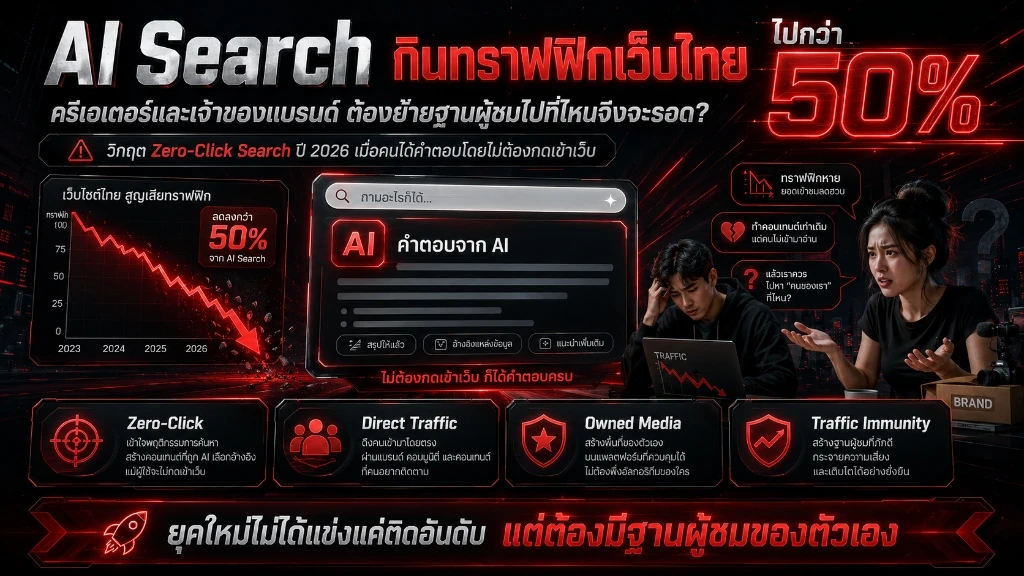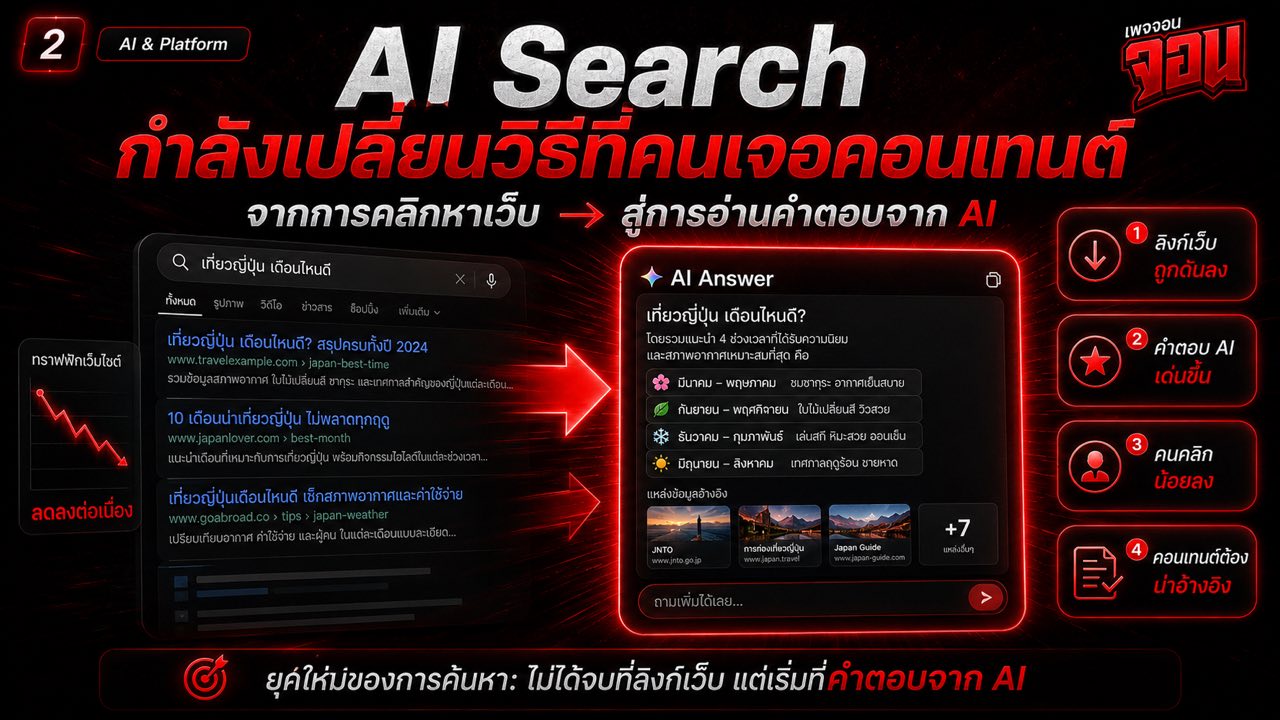
Search used to be a handoff. You typed a question, clicked a result and landed on someone's site, where they could earn an ad impression, a cookie or a sale. AI search changes that. Google's AI summaries and Perplexity answer the question on the results page itself, with a summary, a comparison table or a fix. The user gets what they came for and leaves.
This is called zero-click search, and for publishers it is a structural problem.
What is being claimed
The original Thai article states that Thai news sites, spec-comparison sites and general blogs have seen average Google click declines of roughly 40 to 50 percent, hurting ad revenue and customer acquisition. It gives no source or methodology for those numbers, so read them as a signal from the author, not as measured data. Still, the direction is consistent with what many publishers around the world describe.
The example in the article is simple. Someone searches for EV loan interest rates. Instead of visiting five bank sites, they see one table that compares all of them. Nobody clicks.
What stops being valuable
Generic, general-knowledge content and short news with no distinctive analysis are the easiest things for AI to repackage. That means:
- Broad informational articles written to chase keywords
- Spec summaries with no first-hand testing
- Pageviews as the main success metric
What to build instead: an owned ecosystem
- A newsletter. Direct email delivery bypasses feeds and AI summaries. Substack, Beehiiv or your own site's email system all work.
- A private community. Discord, LINE OpenChat or a closed group lets members exchange in-depth information and builds loyalty that synthetic content cannot copy.
- Audio. Long, emotive audio with humor and a recognizable voice is hard to summarize. Podcasts build a trust that text snippets do not.
Old playbook vs. new playbook
| Old | New |
|---|---|
| Accumulate pageviews for ad revenue | Convert visitors into newsletter subscribers |
| Broad articles chasing SEO keywords | Niche deep-dives with a personal opinion |
| Depend on Google and Facebook referrals | Build recognition so people come directly |
| Generic stock photos | Original photos, premium comparison visuals, distinctive artwork |
Make people search for you, not for the topic
The strongest defense is brand-intent search. When readers type your name or your brand next to the topic, you are not competing with an AI summary for a generic query. That kind of recognition comes from consistent, opinionated work in a specific niche, and from being citable: people quoting you, linking you and coming back.
What to do this month
- Stop treating aggregate search pageviews as your headline number
- Track how many readers become email subscribers or community members
- Pick a niche where you can offer something an AI summary cannot: testing, interviews, lived experience, a point of view
- Put a newsletter signup on every page of your site
My take
Audience behavior has shifted, but the opportunity has not disappeared. It has moved. Direct visits and brand searches make a business resilient to algorithm changes, and those are things AI search cannot take from you.
Free search traffic was always rented. The sooner you start building something you own, the less each algorithm update will hurt.
Written by Ko John. Based on the Thai original on kojohn.com. Traffic figures are the author's claims and are not independently sourced.
Original Thai analysis available at /articles/ai-search-sge-perplexity-creator-survival-thailand-2026